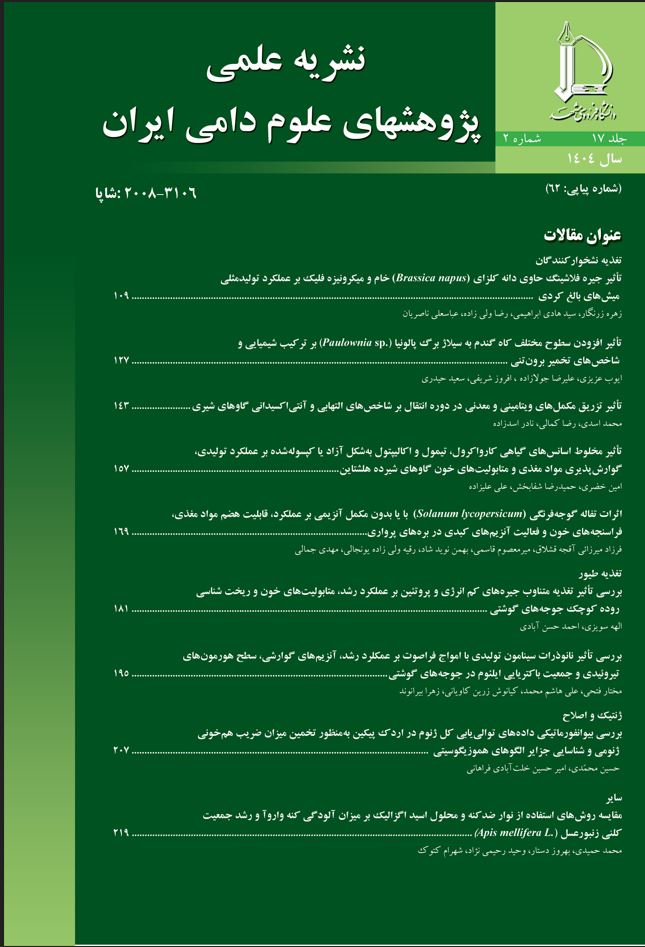
بررسی تأثیر تغذیه متناوب جیره‌های کم انرژی و پروتئین بر عملکرد رشد، متابولیت‌های خون و ریخت ‌شناسی روده کوچک جوجه‌های گوشتی

نوع مقاله : مقاله پژوهشی

نویسندگان

1 گروه علوم دامی دانشکده کشاورزی، دانشگاه فردوسی مشهد، مشهد، ایران

2 گروه علوم دامی، دانشکده کشاورزی، دانشگاه فردوسی مشهد، مشهد، ایران

چکیده

این مطالعه با هدف بررسی اثر تغذیه متناوب جیره‌های ‌کم انرژی-پروتئین و توصیه شده بر عملکرد رشد، متابولیت‌های خون و ریخت‌شناسی روده کوچک جوجه‌های گوشتی انجام شد. تعداد 360 قطعه جوجه‌ گوشتی یک روزه نر سویه تجاری راس 308 از سن یک‌روزگی در قالب طرح کاملاً تصادفی در شش تیمار، پنج تکرار و 12 قطعه جوجه یک‌روزه در هر تکرار در جایگاه‌های بستری قرار گرفتند. تیمارهای آزمایش شامل 1- شاهد: جیره بر‌اساس توصیه سویه راس 308؛ جیره‌های شماره 2، 3 و 4: به‌ترتیب با پنج، 5/7 و 10 درصد کاهش پروتئین خام و انرژی جیره؛ 5- تغذیه جیره شاهد و شماره سه به‌صورت یک روز در میان؛ 6- تغذیه جیره شاهد و جیره شماره چهار؛ به‌صورت یک روز در میان تا انتهای دوره رشد بودند. نسبت انرژی به پروتئین خام در تمام تیمارها یکسان بود. تیمارهای غذایی تأثیر معنی­داری بر عملکرد رشد، صفات لاشه و شاخص­های بیوشیمیایی خون نداشتند. جیره‌هایی که پروتئین خام آن‌ها پنج و 5/7 درصد کاهش درصد کاهش یافته بود و به‌صورت یک روز در میان به‌ترتیب با جیره‌های شاهد و 10 درصد کاهش پروتئین تغذیه شدند، باعث افزایش معنی‌دار ارتفاع پرزهای ژژنوم در مقایسه با شاهد شدند (05/0 > P). جیره‌های با پنج، 5/7 و 10 درصد کاهش در پروتئین خام باعث افزایش معنی‌دار (05/0 > P) ضخامت لایه ماهیچه‌ای ژژنوم در مقایسه با شاهد شدند. نسبت ارتفاع پرز به عمق کریپت در ژژنوم جوجه‌های گوشتی تغذیه شده با جیره‌های پنج، 5/7 و 10 درصد کاهش در پروتئین خام به‌طور معنی‌داری بیشتر از شاهد بود. این نسبت در تیمار تغذیه یک روز در میان جیره شاهد با جیره‌ 5/7 درصد کاهش پروتئین خام به‌طور معنی‌داری کمتر از شاهد بود. به‌طور کلی، کاهش پروتئین خام جیره تا 10 درصد مقدار توصیه شده و تغذیه یک روز در میان آن با جیره شاهد تأثیر منفی بر عملکرد رشد، متابولیت‌های خون و شاخص‌های بافت‌شناسی ژژنوم نداشت.

کلیدواژه‌ها

موضوعات


عنوان مقاله [English]

Investigating the Impact of Alternating Low-Energy and Protein Diets on Growth Performance, Blood Metabolites, and Small Intestine Morphology in Broiler Chickens

نویسندگان [English]

  • Elahe Soveyzi 1
  • Ahmad Hassanabadi 2
1 Department of Animal Science, Faculty of Agriculture, Ferdowsi University of Mashhad, Mashhad, Iran
2 Department of Animal Science, Faculty of Agriculture, Ferdowsi University of Mashhad, Mashhad, Iran
چکیده [English]

Introduction: The poultry industry is a crucial source of protein for human consumption, but nitrogen disposal, a major cause of environmental pollution, has been a significant concern in recent decades (Fasina et al., 2010). Various solutions have been proposed to mitigate environmental pollution from poultry manure, with one of the most practical being the use of diets with lower protein levels. It has been demonstrated that low-energy and protein diets can save costs and reduce nitrogen excretion (Gholami et al., 2015). Phase, intermittent, and selective feeding are among the feeding methods, each offering distinct benefits. These rations not only reduce feed costs but also decrease nitrogen excretion into the environment and minimize metabolic disorders such as ascites. They are particularly recommended for maintaining birds under heat stress conditions (Pope et al., 2004). Recent studies have shown that sequential feeding effectively reduces chick mortality. Intermittent feed restriction in young broilers modifies hormonal status and contributes to a metabolic state that can enhance immune capacity (Sauvant et al., 2002). This study aims to investigate the effect of alternating low-energy and protein diets with standard diets in broilers, focusing on growth performance, blood metabolites, and small intestine morphology.
Materials and Methods: A total of 360 one-day-old Ross 308 male broilers were divided into six treatment groups, with five replicates per group and 12 birds per replicate. The treatments were as follow: 1) Control Diet: Formulated according to Ross 308 nutrient recommendations and fed throughout the experiment. 2) 5% Reduced Crude Protein (CP) Diet: Fed from day one to the end of the experiment. 3)7.5 % Reduced CP Diet: Fed from day one to the end of the experiment. 4) 10% Reduced CP Diet: Fed from day one to the end of the experiment. 5). Alternating Diets 1 and 3: Switched every other day. 6) Alternating Diets 1 and 4: Switched every other day. Chickens had ad libitum access to water and feed. They were provided with 23 hours of light and 1 hour of darkness daily. The initial room temperature was set at 32°C and was gradually reduced by 0.5°C per day until it reached 21°C by day 21, after which it remained constant. The amount of feed consumed in periods (1-10, 11-24, 1-24 days) was measured in each replicate pen. At the age of 24 days, one bird from each pen was slaughtered and dissected to determine the length of the duodenum, jejunum, and ileum. Subsequently, an intestinal section was separated from the jejunum midpoint and histology was performed on it. At the age of 24 days, one bird from each experimental unit was randomly selected and blood was collected from the wing vein. The resulting blood was transferred to test tubes. The samples were kept at room temperature for 30 minutes, then centrifuged at 3000 rpm for 15 minutes, and the serum was separated from the blood. Serum samples were poured into microtubes and kept at -20°C until analysis by an auto analyzer (Bio Systems S.A. – Costa Brava 30,08030 Barcelona, Spain). Serum contents were measured in terms of cholesterol, triglyceride, LDL-C, HDL-C, and blood uric acid by auto analyzer. The data obtained from this experiment were analyzed using SAS statistical software and the General Linear Models (GLM) procedure, and the treatment means were compared using Duncan's new multiple range test at p < 0.05.
Results and Discussion: The results showed no significant differences between treatments in feed conversion ratio and daily feed intake (P > 0.05). Weight gain from days 1 to 24 also showed no significant differences (P > 0.05). Treatments did not significantly affect carcass traits, jejunum villi width, or crypt depth (P > 0.05). However, villus height in treatment 3 was higher than in other treatments and significantly higher than control. Muscle layer thickness in treatment 2 was significantly greater than in other treatments and the control (P < 0.05). Blood biochemical parameters were not significantly different among treatments.
Conclusion: Overall, the treatment with 5% reduced crude protein, improved small intestine morphology. Reducing crude protein by up to 10% and alternating it with the control diet did not negatively affect growth, blood metabolites, or jejunum morphology. Since growth performance was unaffected, all treatments are viable options.

کلیدواژه‌ها [English]

  • Blood metabolites
  • Broiler
  • Low energy and protein diets
  • Performance

©2023 The author(s). This is an open access article distributed under Creative Commons Attribution 4.0 International License (CC BY 4.0), which permits use, sharing, adaptation, distribution and reproduction in any medium or format, as long as you give appropriate credit to the original author(s) and the source.

  1. Abbasi, M. A., Mahdavi, A. H., Samie, A. H., & Jahanian, R. (2014). Effects of different levels of dietary crude protein and threonine on performance, humoral immune responses and intestinal morphology of broiler chicks. Brazilian Journal of Poultry Science, 16, 35-44. https://doi.org/10.1590/S1516-635X2014000100005
  2. Aftab, U., Ashraf, M., & Jiang, Z. (2006). Low protein diets for broilers. World's Poultry Science Journal, 62(4), 688-701. https://doi.org/10.1017/S0043933906001218
  3. Awad, E. A., Fadlullah, M., Zulkifli, I., Farjam, A. S., & Chwen, L. T. (2014). Amino acids fortification of low-protein diet for broilers under tropical climate: Ideal essential amino acids profile. Italian Journal of Animal Science, 13(2), 3166. https://doi.org/10.4081/ijas.2014.3166  
  4. Bregendahl, K., Sell, J. L., & Zimmerman, D. R. (2002). Effect of low-protein diets on growth performance and body composition of broiler chicks. Poultry Science, 81(8), 1156-1167. https://doi.org/10.1093/ps/81.8.1156
  5. Dozier III, W. A., & Moran Jr, E. T. (2002). Dimensions and light reflectance of broiler breast fillets: Influence of strain, sex, and feeding regimen. Journal of Applied Poultry research, 11(2), 202-208. https://doi.org/10.1093/japr/11.2.202
  6. Fasina, Y. O., Hoerr, F. J., McKee, S. R., & Conner, D. E. (2010). Influence of Salmonella enterica serovar Typhimurium infection on intestinal goblet cells and villous morphology in broiler chicks. Avian Diseases, 54(2), 841-847. https://doi.org/10.1637/9055-090809-Reg.1
  7. Gholami, M., Hassanabadi, A., Nasiri Moghadam, H., & Golian, A. (2015). Effects of different levels of digestible arginine and protein in starter diets containing ideal amino acids ratio on performance, carcass traits and serum parameters in broiler chickens. Iranian Journal of Animal Science Research, 7(2), 139-152. (In Persian)
  8. Golian, A., Azghadi, A., & Pilevar, M. (2010). Influence of various levels of energy and protein on performance and humoral immune responses in broiler chicks. Global Veterinaria, 4(5), 434-440.
  9. Khajali, F., & Wideman, R. F. (2010). Dietary arginine: metabolic, environmental, immunological and physiological interrelationships. World's Poultry Science Journal, 66(4), 751-766. https://doi.org/10.1017/S0043933910000711
  10. Laudadio, V., Passantino, L., Perillo, A., Lopresti, G., Passantino, A., Khan, R. U., & Tufarelli, V. (2012). Productive performance and histological features of intestinal mucosa of broiler chickens fed different dietary protein levels. Poultry Science, 91(1), 265-270. https://doi.org/10.3382/ps.2011-01675
  11. Leclercq, B. E. R. N. A. R. D. (1998). Lysine: specific effects of lysine on broiler production: comparison with threonine and valine. Poultry science, 77(1), 118-123.
  12. Leeson, S., & Summers, J. D. (2001). Nutrition of the chicken. 4th ed. ‎Nottingham University Press.
  13. Nukreaw, R., Bunchasak, C., Markvichitr, K., Choothesa, A., Prasanpanich, S., & Loongyai, W. (2011). Effects of methionine supplementation in low-protein diets and subsequent re-feeding on growth performance, liver and serum lipid profile, body composition and carcass quality of broiler chickens at 42 days of age. The Journal of Poultry Science, 48(4), 229-238. https://doi.org/10.2141/jpsa.010064
  14. Pope, T., & Emmert, J. L. (2002). Impact of phase-feeding on the growth performance of broilers subjected to high environmental temperatures. Poultry Science, 81(4), 504-511. https://doi.org/10.1093/ps/81.4.504
  15. Pope, T., Loupe, L. N., Pillai, P. B., & Emmert, J. L. (2004). Growth performance and nitrogen excretion of broilers using a phase-feeding approach from twenty-one to sixty-three days of age. Poultry science, 83(4), 676-682. https://doi.org/10.1093/ps/83.4.676
  16. Rada, V., Foltyn, M., Lichovníková, M., & Musilová, A. (2013). Effects of protease supplementation of low protein broiler diets on growth parameters and carcass characteristic. Mendelnet, 2013, 268-272.
  17. Rehman, Z. U., Kamran, J., Abd El-Hack, M. E., Alagawany, M., Bhatti, S. A., Ahmad, G., Saleem, A., Ullah, Z., Yameen, R. M. K., & Ding, C. (2017). Influence of low-protein and low-amino acid diets with different sources of protease on performance, carcasses and nitrogen retention of broiler chickens. Animal Production Science, 58(9), 1625-1631. https://doi.org/10.1071/AN16687
  18. Rosebrough, R. W., McMurtry, J. P., & Vasilatos-Younken, R. (1999). Dietary protein effects on the broiler's adaptation to triiodothyronine. Growth, Development, and Aging: GDA, 63(3), 85-98.
  19. 2014. SAS User’s Guide: Statistics. Version 9.4 Edition. SAS Institute Inc., Cary, NC.
  20. Sauvant, D., Perez, J. M., & Tran, G. (2002). Tables de composition et de valeur nutritive des matières premières destinées aux animaux d’élevage: porcs, volailles, bovines, ovins, caprins, lapins, chevaux, poisons. INRA Editions, Versailles.
  21. Selle, P. H., Dorigam, J. C. D. P., Lemme, A., Chrystal, P. V., & Liu, S. Y. (2020). Synthetic and crystalline amino acids: Alternatives to soybean meal in chicken-meat production. Animals, 10(4), 729. https://doi.org/10.3390/ani10040729
  22. Wilkie, D. C., Van Kessel, A. G., White, L. J., Laarveld, B., & Drew, M. D. (2005). Dietary amino acids affect intestinal Clostridium perfringens populations in broiler chickens. Canadian Journal of Animal Science, 85(2), 185-193. https://doi.org/10.4141/A04-070
  23. Yang, Y. X., Guo, J., Yoon, S. Y., Jin, Z., Choi, J. Y., Piao, X. S., Kim, B. W., Ohh, S. J., Wang, M. H., & Chae, B. J. (2009). Early energy and protein reduction: effects on growth, blood profiles and expression of genes related to protein and fat metabolism in broilers. British Poultry Science, 50(2), 218-227. https://doi.org/1080/00071660902736706
  24. Zamani, M., Rezaei, M., Teimouri Yansari, A., Sayyahzadeh, H., & Niknafs, F. (2012). The effect of different levels of energy and protein of the final ration on performance, carcass characteristics and blood serum lipids concentration of broiler chickens. Research on Animal Production, 32, 86-692. (In Persian)

Zarate, A. J., Moran Jr, E. T., & Burnham, D. J. (2003). Reducing crude protein and increasing limiting essential amino acid levels with summer-reared, slow-and fast-feathering broilers. Journal of Applied Poultry Research, 12(2), 160-168.  https://doi.org/10.1093/japr/12.2.160
CAPTCHA Image